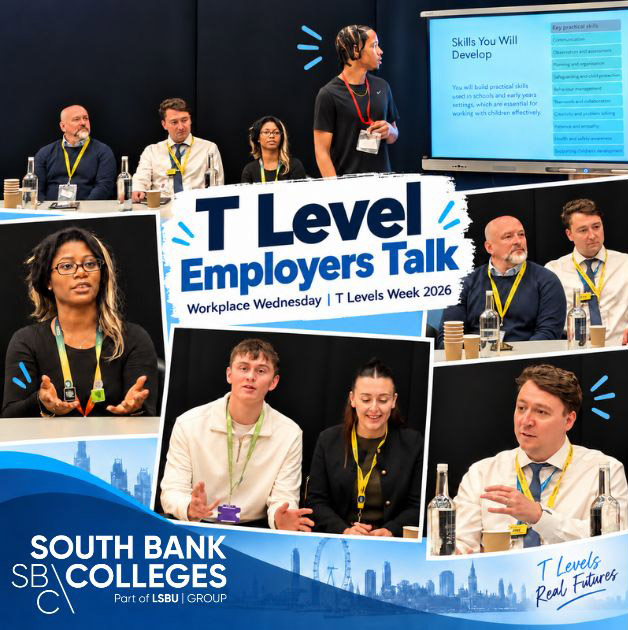
What do employers really look for in young people entering the workplace? How can a T Level industry placement lead to an exciting career? And what skills matter most when applying for that first job? These were just some of the questions explored during a special Workplace Wednesday event at South Bank Colleges, bringing students face-to-face with industry professionals.
As part of T Levels Week 2026 (19–23 October), South Bank Colleges welcomed representatives from the construction, engineering and healthcare sectors for an engaging panel discussion designed to help current and prospective T Level students understand the opportunities awaiting them beyond the classroom.
The event brought together four professionals with very different career journeys, but one shared message: practical experience, curiosity and a willingness to learn can open doors that students might never have imagined.
Meet the Industry Experts
The Workplace Wednesday panel featured:
-
Rebecca Davies, Social Value Manager at Willmott Dixon Interiors.
-
Karl Rushen, UK&I Head of Discipline – Digital Delivery at COWI UK.
-
Alex Gull, Workforce and Academy Programme Manager at Guy's and St Thomas' NHS Foundation Trust.
-
Adetola Ogunyemi, Careers & Progression Officer at South Bank Colleges.
The session began with an introduction from two students, Antonio and Mark, who explained the benefits of T Levels, including their equivalence in size to three A Levels and the opportunity to develop valuable professional skills through industry placements.
Different Journeys, Exciting Destinations
One of the most encouraging messages from the discussion was that successful careers rarely follow a perfectly straight path.
Karl Rushen described how he left his A Level studies at 17 to begin an apprenticeship with a civil engineering company. Nearly four decades later, he now leads digital delivery across COWI's UK and Ireland business and contributes to improvements in the company's global operations.
Rebecca Davies shared an equally unconventional journey. After leaving college, she spent several years working in hospitality before moving into careers education and eventually joining Willmott Dixon Interiors as a Social Value Manager.
Meanwhile, Alex Gull explained that the NHS offers far more careers than many students might expect. Alongside doctors and nurses, the organisation employs engineers, project managers, technical specialists and many other professionals who help keep hospitals running.
Adetola Ogunyemi also described her move from business-to-business account management into careers guidance, driven by her interest in helping students from different backgrounds access opportunities that might otherwise seem out of reach.
Together, their experiences demonstrated that career paths can change direction, and that skills gained in one industry can often prove valuable in another.
Making the Most of a T Level Industry Placement
A central theme of Workplace Wednesday was the importance of the industry placement, one of the defining features of a T Level qualification.
With students completing a minimum of 315 hours in a real working environment, placements provide far more than an opportunity to observe professionals at work.
They allow students to demonstrate their abilities, develop confidence, build professional relationships and discover what working in their chosen industry is really like.
The panel encouraged students to approach placements with enthusiasm, ask questions, show initiative and take an interest in the wider organisation.
A positive attitude, willingness to learn and genuine curiosity can make just as much of an impression as technical knowledge.
Karl shared a particularly encouraging example of a T Level student who completed a placement within his discipline at COWI. Although her original interests lay in a different area of engineering and technology, the experience opened up new possibilities. She subsequently joined the business as an apprentice.
It was a powerful example of how industry placements can create genuine progression opportunities.
The speakers also highlighted how a placement can act almost like an extended job interview, giving employers weeks to see a student's abilities, attitude and potential in action.
What If a Placement Isn't What a Student Expected?
Not every placement will confirm that a particular career is the right choice, and the panel was keen to explain why that shouldn't be seen as a failure.
Rebecca recalled completing work experience in a nursery and discovering that working with young children wasn't the career she wanted to pursue.
Rather than being a wasted opportunity, the experience helped her understand her interests before committing to further study.
She encouraged students to remain curious, even if their initial placement didn't match their expectations.
For example, a student placed in quantity surveying might discover an interest in site management, sustainability or health and safety. By asking questions and making connections, they might secure an opportunity to explore another department.
Sometimes discovering what a student doesn't want to do can be just as valuable as discovering what they love.
The Skills Employers Really Want
When asked what qualities they look for in potential employees and apprentices, the panellists offered practical advice that students could put into action immediately.
Communication, time management, adaptability, resilience and a positive attitude were repeatedly highlighted as essential workplace skills.
Rebecca emphasised the importance of punctuality, particularly when attending interviews, and encouraged students to demonstrate transferable skills from part-time jobs, volunteering and other experiences.
Adetola explained that employers often value well-rounded applicants. Being a student representative, joining a club, attending an employability workshop or taking part in enrichment activities can all demonstrate qualities such as responsibility, teamwork and leadership.
Alex encouraged students not to underestimate skills developed in their own time, recalling an example of someone whose experience building computers for family and friends helped them secure an entry-level IT position.
The message was clear: students don't need years of professional experience to demonstrate their potential.
Activities outside the classroom can provide excellent evidence of skills that employers want to see.
Building Confidence, Connections and Resilience
The discussion also explored the importance of networking and learning how to communicate with professionals.
Students were encouraged to take advantage of opportunities to meet employers, attend industry events and develop relationships during their placements.
These connections can sometimes lead to further work experience, apprenticeships or job opportunities.
The panel also acknowledged that entering employment can be challenging. Applications may be unsuccessful, career plans may change and workplace responsibilities can bring new pressures.
However, developing resilience and learning to adapt to setbacks are important parts of building a successful career.
The speakers reminded students that there is no single route to success, and that being prepared to explore new opportunities can make all the difference.
Bringing Education and Employment Together
Workplace Wednesday was a valuable reminder of what makes T Levels such an exciting qualification.
By combining classroom learning with substantial industry experience, T Levels help students develop technical knowledge alongside the practical and professional skills needed in the workplace.
Events like this also give students an opportunity to hear directly from employers about the qualities they value, the different routes into their industries and the opportunities available to young people starting their careers.
As South Bank Colleges continues celebrating T Levels Week 2026, the message from Workplace Wednesday is an encouraging one: a successful career isn't always about knowing exactly where the journey will lead. It's about making the most of opportunities, staying curious and being willing to learn along the way.
Interested in a T Level?
Discover how practical learning, industry placements and specialist technical education could help shape the future.
Explore the T Level courses available at South Bank Colleges: